

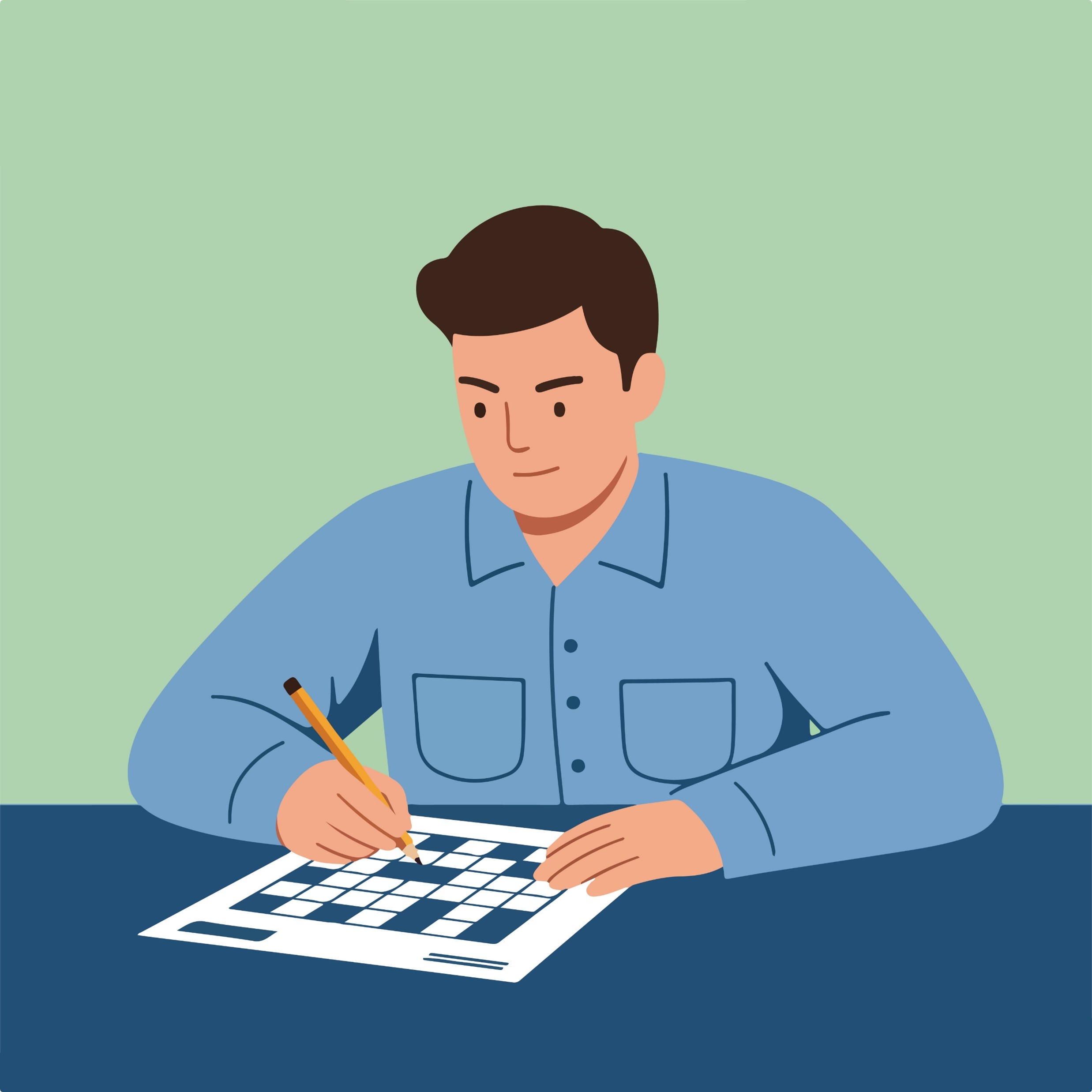
I was stuck. The answer I was certain was right made everything around it fall apart. I'd committed in ink, and now three intersecting clues were impossible to solve. I stared at the grid, frustrated, until I finally admitted the truth: my first instinct was wrong.
Sound familiar?
Last month, a client—a newly promoted manager—told me she'd rolled out a new project workflow she was "certain" would solve her team's efficiency problems. Two weeks in, everything was breaking. People were confused, deadlines were slipping, and she felt like a failure. "I should have known better," she said. "I should have gotten it right the first time."
That's when I told her about crossword puzzles.
There's a crossword culture, complete with unwritten rules:
I break every single one. And I'm better for it.
If I don't know who Othello's enemy is and I don't look it up, I simply continue to be ignorant. Where's the value in that? Looking up Iago doesn't diminish my puzzle-solving skills—it expands my knowledge for every future puzzle.
When I see the word "produce" in a clue, I have to wonder—is it a noun or a verb? If the clue is "Five train in Brooklyn," is it referring to the subway system? But there is no 5 train in Brooklyn!
When I try an answer that makes sense and fits, but nothing around it works, I realize I need to be flexible. My first thought is wrong. The eraser is my friend. I try again.
Or I work on another section of the puzzle. I run errands. I get a snack. When I come back with fresh eyes, I see it: Ohhh—Five (who) train in Brooklyn! "Train" is a verb, not a noun. Got it. (The answer is "Nets," by the way.)
These rigid rules kill the very flexibility our brains need. They're so intimidating that many people give up too quickly or assume they're simply "not smart enough" and don't even try. That's a shame, because crossword puzzles are fantastic brain exercise—they strengthen neural connections, challenge memory retrieval, vocabulary, logic, and pattern recognition.
But here's the thing: the worst advice for solving puzzles is also the worst advice for leading people.
Not a puzzler? Here's what you need to know:
Crosswords give you intersecting clues. Get one answer wrong, and everything connected to it becomes impossible to solve. Sound like any organizational problems you know?
Or think about taking a photo: you snap, check, adjust the light, shift your angle, try again. Nobody calls those twelve tries "failure." That's just how you get it right.
In puzzles, flexibility looks like this:
In leadership, flexibility looks like this:
My client didn't need to scrap her entire workflow. She needed to admit her first design was wrong, ask her team what wasn't working, and revise. Just like erasing a wrong answer and writing in the right one.
The crossword rules demand certainty. Leadership requires the opposite.
"I don't know."
Like looking up Iago, admitting knowledge gaps keeps you growing. The leaders I coach who say "I don't know—help me understand" build stronger, more collaborative teams than those who pretend to have all the answers.
"I need help."
Even expert puzzlers collaborate. They share strategies, compare notes, celebrate each other's wins. Why do leaders pretend they're solo? Your team has insight you don't. Your peers have perspective you need. Asking for help isn't weakness—it's wisdom.
"I was wrong."
The eraser is your friend, even when you've written in ink. Changing course isn't failure—it's strength. It tells your team that getting it right matters more than being right from the start.
"I'm sorry."
When you've filled in wrong answers that blocked your team's progress, own it. This one transcends the puzzle metaphor, but it enables everything else. Apology creates space for honesty, revision, and trust.
Remember learning to ride a bike? You fell. A lot. No one handed you a bicycle and said, "Get it right the first time, in ink, or you're not a real cyclist."
Think about making dinner. You taste the sauce, realize it needs something—more garlic? A squeeze of lemon? You adjust, taste again, maybe add a pinch of salt. You don't announce the recipe once and refuse to adapt. You respond to what's actually happening in the pot. Nobody calls that failure. We call it cooking.
Your leadership deserves the same grace.
When you model flexibility—when you use pencil instead of ink, when you look up answers, when you erase and try again—you give your team permission to do the same. You create a culture where "try, fail, try harder, fail better" isn't just a motto. It's how brilliant work actually gets done.
That client? She revised her workflow with input from her team. It's working beautifully now. And she's started doing crossword puzzles—in pencil—every Sunday morning.
Where in your leadership are you using "ink only" when you need a pencil?
What would it look like to give yourself—and your team—permission to erase? To look up answers? To come back to a problem with fresh eyes?
The next time you're stuck on a decision, imagine you're holding a pencil, not a pen.
What becomes possible?
Ruth Bergman is a leadership and performance coach specializing in helping newly promoted managers transition from individual contributor to leadership roles. She solves crossword puzzles in pencil, takes breaks when she's stuck, and looks up answers without shame. Learn more about her Leadership Reset workshop at listenandlead.org.